
Market Notes from Home Waters
Week of Oct. 26 to Nov. 1
Fall in Tampa Bay has a way of slowing the noise. If you're wondering what the housing market actually did last week — for your next purchase, a sale you've been timing, or the home you already love — this week's Market Notes walk through the numbers that matter, in plain language, with Tampa Bay first.
Tampa Bay / Hillsborough: Steady ground — and real help for first-time buyers
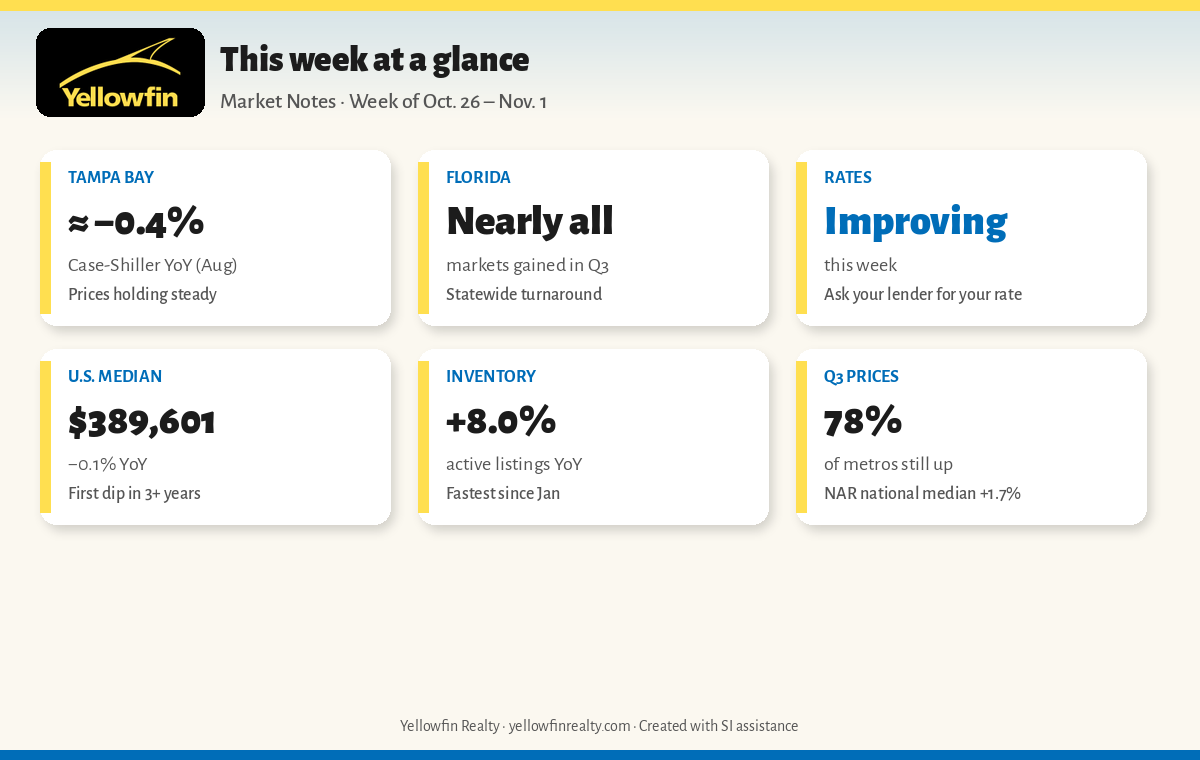
Local prices are holding roughly flat. Tampa's Case-Shiller index was down about 0.4% year over year in August (FRED / S&P Cotality Case-Shiller, Oct. 27 release).
There's also a bright note for buyers just getting started. The City of Tampa's DARE program helped a record 71 buyers close in fiscal 2026 with $5.31 million in down-payment and closing-cost help — up to $50,000 per eligible buyer for homes inside city limits. Applications are still open (Tampa Bay Business & Wealth, Oct. 28). If that might be part of your plan, a Yellowfin agent can walk you through whether it fits.
Florida: Prices turning the corner
Across the state, the tone is warming. After a year of declines in many Florida markets, NAR reported that "homes in nearly all Florida markets are showing price gains" in the third quarter (NAR, Oct. 29).
Miami's Case-Shiller index was up about 4.3% year over year in August (FRED / S&P Cotality Case-Shiller, Oct. 27 release).
National: A quieter market with more homes to choose from
Zooming out, the national picture helps explain why your local search may feel different than it did a year or two ago.
Prices are essentially flat. Redfin's median sale price was $389,601 for the four weeks ending Oct. 25, down 0.1% year over year — the first decline in more than three years. Pending sales hit the lowest level in Redfin's records, 15.9% below last year (Redfin, Oct. 29).
Inventory is building because buyers are slow — not because sellers are flooding in. Realtor.com shows active listings up 8.0% year over year, the fastest growth since late January. New listings are down 1.5%, and the median listing price is down 1.4% to $414,000 (Realtor.com, Oct. 29).
Over a longer lens, quarterly prices are still up. NAR's Q3 national median single-family price was $432,900, up 1.7%, and prices rose in 78% of metros (NAR, Oct. 29).
How the regions compare
Northeast — strongest region for price growth. The Q3 median was $561,500, up 4.0% year over year. Rochester, N.Y. (+10.9%) and York-Hanover, Pa. (+9.2%) were among the top 10 large-market gainers (NAR, Oct. 29). Supply is opening up in some metros: new listings rose 14.4% in Newark and 12.8% in Boston year over year, and New Brunswick, N.J. prices were up 8.4% (Redfin, Oct. 29).
Midwest — affordable and still appreciating. The Q3 median was $342,500, up 3.6%. Grand Rapids, Cleveland, and Fort Wayne all made NAR's top 10 for gains, and NAR's chief economist called the Midwest "exceptional value" (NAR, Oct. 29). Chicago led all 20 Case-Shiller cities at +6.7% year over year in August (S&P Cotality Case-Shiller, Oct. 27). Not every market is up: Kansas City sale prices were down 4.3%, and Minneapolis new listings fell 8% (Redfin, Oct. 29).
South (including the Deep South and Texas) — prices barely moving; demand cooled. The Q3 median was $374,900, up 1.0%. Gulfport-Biloxi (+11.0%), Jackson, Miss. (+10.1%), and Beaumont-Port Arthur, Texas (+9.9%) were the standouts (NAR, Oct. 29). Demand pulled back hard: Atlanta pending sales were down 25.9% year over year. New listings fell 26.5% in Atlanta, 18.7% in San Antonio, and 17.6% in Dallas. Austin (−4.6%) and Nashville (−3.3%) prices slipped (Redfin, Oct. 29). New construction is still the South's market: September new-home sales in the South ran at a 413,000 annual rate, down 6.6% month over month, and the region made up about 61% of all U.S. new-home sales (Census, Oct. 27; Haver Analytics).
West (including the West Coast and Mountain states) — the only region where Q3 prices fell. The Q3 median was $629,000, down 0.6%. Nine of the 10 most expensive U.S. markets are in California or Hawaii, led by San Jose at $1.92 million (NAR, Oct. 29). The split is sharp: Seattle sale prices were down 5.1% and pending sales down 31.6%; San Diego (−25.3%), Las Vegas (−22.7%), and Denver (−22.3%) pending sales also fell steeply — while San Francisco prices were up 15% (Redfin, Oct. 29). Seattle was the weakest Case-Shiller city in August at −2.0% year over year (S&P Cotality Case-Shiller, Oct. 27).
Rates
What this means for buyers
You have more choice — and often more leverage — than you've had in years. Active listings are rising nationally while new listings aren't flooding the market, which usually means a calmer tour schedule and more room to negotiate on condition, closing timeline, or concessions. Locally, flat Tampa Bay prices and an open City of Tampa DARE program are especially useful if you're a first-time or move-up buyer shopping inside city limits.
A practical next step: get clear on your budget with your lender, then tour with patience. The homes that fit your story are still out there — and you may not need to rush the way buyers did a few years ago.
What this means for sellers
Sellers who price thoughtfully from day one are still the ones finding a path to closing. Nationally, inventory is up and pending sales are soft, so overpricing tends to sit. Pricing to the current comps — not last spring's peak — and presenting the home well remains the difference between a quiet listing and a signed contract.
If you're weighing a sale in Tampa Bay, flat local prices aren't a reason to panic; they're a reason to be precise. A Yellowfin agent can help you read the neighborhood-level story, not just the metro headline.
What we're watching next week
- Whether active listings keep climbing at this pace — more choice for buyers, more strategy needed for sellers.
- How Florida's Q3 price turnaround shows up in fresh monthly data for Tampa Bay neighborhoods.
- New-home sales trends in the South, which still account for the majority of U.S. new construction activity.
- Any further shift in the rate environment — and what your lender says that means for your specific goals.
Come back next week
Every home here has a story. Whether you're looking for your first spot near the water, a quieter street for the next chapter, or a smart timing call on a sale, we'd love to listen.
Reach out to Yellowfin Realty anytime at yellowfinrealty.com — a boutique Tampa Bay team of about 40 agents, here when you're ready.
Drafted with SI assistance.